Ocean Soup
VANDENYNO SRIUBOJE
2023
IN OCEAN SOUP
The work is created using discarded synthetic (or mixed) fibre clothing from DĖK‘ui stops in Vilnius
2023
Approximately 8 million tonnes of plastic waste enter the oceans every year.
A peril to marine life and ecosystems, posing harm to humans.
Microplastics, resembling a soup, consist of particles smaller than 5 mm, ingested by aquatic organisms traverses the food chain. They are omnipresent: in drinking water, salt, beer, and the soil where vegetables grow.
The Baltic Sea stands as the most microplastically polluted sea in Europe.
While most plastic pollution results from littering, not all plastic waste stems from such actions.
The problem is carried with us – synthetic garments constantly shed. Washing them at home releases particles into the environment through water.
Studies reveal that up to 35% of all microplastics originate from synthetic textiles, constituting the most common form of micro-litter. Marine fish, crustaceans, and bivalves ingest these particles.
Fish populations are decreasing rapidly, and pollution contributes to oxygen depletion.
Research on fish indicates the presence of microplastic particles in gills, muscles, and the entire digestive tract, particularly in demersal fish.
Marine biologists predict that by 2050, the amount of microplastic could outweigh the total number of fish in the water.
VANDENYNO SRIUBOJE
Parodos menininkės:
LIUCIJA DERVINYTĖ
Grafinis dizainas: Liucija Dervinytė.
IN OCEAN SOUP
Centered around the Baltic Sea, one of the most polluted seas globally and the most microplastic-polluted sea in Europe, the exhibition delves into the prevalence and impact of microplastics, emphasizing their presence in everyday objects. It encourages reflection on the role of humans in the growing crisis, particularly highlighting the contribution of synthetic textiles to marine pollution and the decline in fish populations. Visitors are invited to contemplate the consequences of individual choices in the face of environmental challenges.
Artists:
The artist's works explore the ecological impact of fulfilling human desires, focusing on issues of attachment, memory, and constraints. Characterized by a search for ready-made solutions, conceptual presentation, recreation, empowerment of natural resources, performativity, and documentation, Martyna is currently pursuing a Master's degree in Textile Art and Design at the Vilnius Academy of Arts. She is also a participant in the European project Weave Up!, which aims to preserve, promote, and develop the diversity of European cultural heritage, with a focus on Lithuania and France.
LIUCIJA DERVINYTĖ
The artist explores the theme of connections through the relationship between culture and nature, talking about the interconnectedness and the impact of human as an integral part of nature on the environment. Her creative expression, based on the principle of collage, combines textiles, painting, recycled objects and textual information. She holds a BA in Textiles from the University of Edinburgh and an MA from Vilnius Academy of Arts. In addition to her artistic pursuits, Lucija is actively involved in curating and organising exhibitions and cultural events, forming communities, and is a co-founder of the cultural space „Ideas Block – Kompresorinė“, „Arttice“ platform for cultural networking.
Exhibition will run until the 25th of February.
There will be two meetings with the artsist held on the 17th of February, 1pm, and 25th of February, 4pm.
This exhibition is part of the Vilnius City Municipality's initiative "SU-MENĖK". More information:
Graphic design: Liucija Dervinytė.
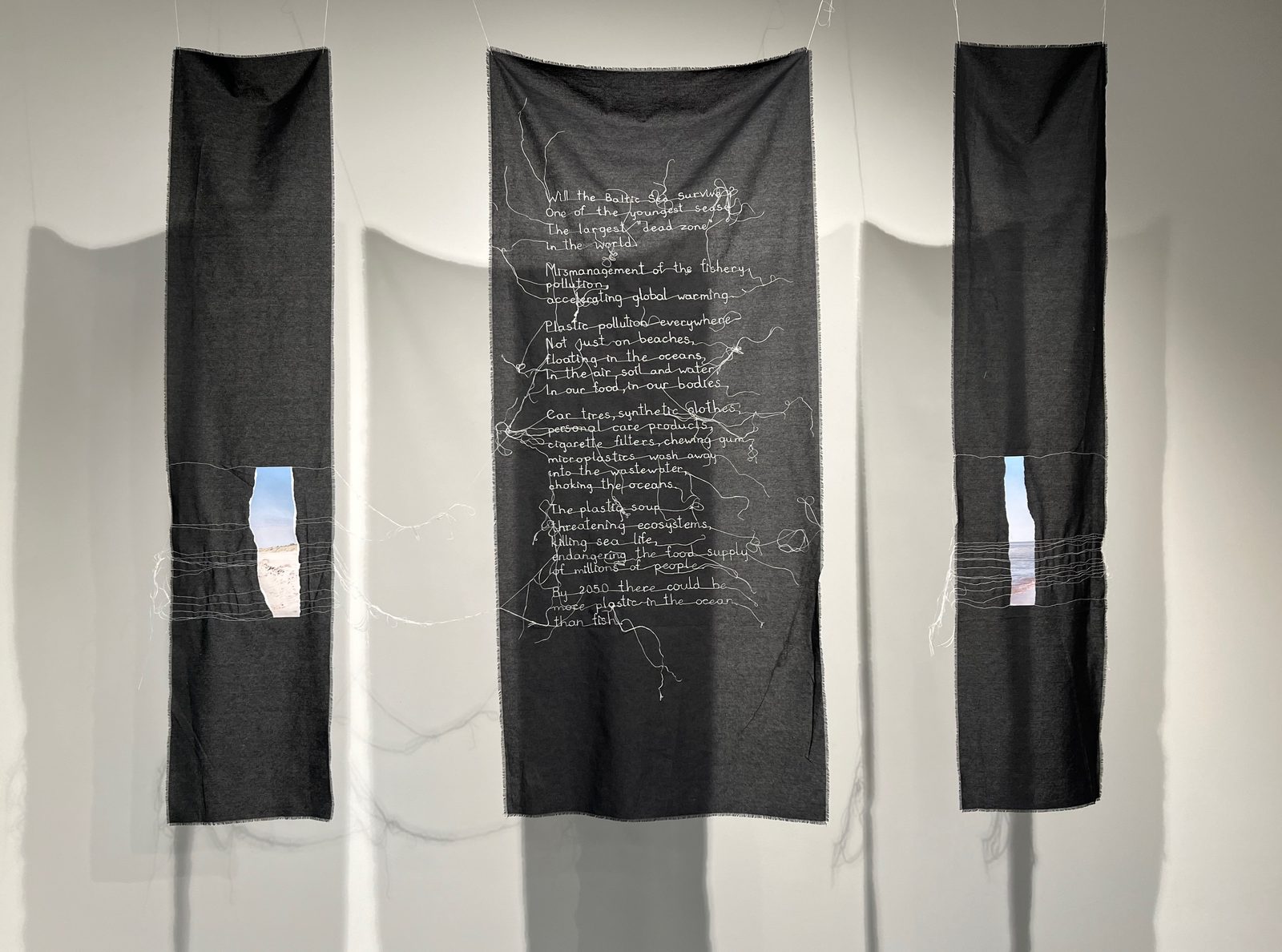
Will the Baltic Sea survive?
One of the youngest seas –
the largest “dead zone”
in the world.
mismanagement of the fishery,
pollution,
accelerating global warming.
Plastic pollution everywhere –
Not just on beaches,
floating in the ocean,
In the air, soil and water,
in our food and our bodies.
Car tires, synthetic clothes,
personal care products,
cigarette filters, chewing gum –
microplastics wash away
into the wastewater,
choking the oceans.
The plastic soup
threatening ecosystems,
killing sea life,
endangering the food supply
of millions of people.
by 2050 there could be
more plastic in the ocean
than fish.
MES VANDENYNAI / WE THE OCEANS
Liucija Dervinytė
2024
didžiausia "negyvoji zona"
pasaulyje.
Plastiko tarša visur -
Ne tik paplūdimiuose,
plūduriuoja vandenyne,
asmens higienos produktai,
mikroplastikas nuplaunamas į nuotekas,
dusina vandenynus.
Plastiko sriuba
kelia pavojų maisto tiekimui
iki 2050 m. vandenyje gali būti
@liucijasmindgarden
liucija.ideas-block.com
SINTETINIS PEIZAŽAS / SYNTHETIC LANDSCAPE
2023
Could this be what a synthetic landscape could look like?
According to Louise Bourgeois, our body can be considered topologically as a landscape with mounds and valleys, caves and pits.
@plioplyte_zuje
http://www.glis.lt/?pid=118
https://education.nationalgeographic.org/resource/microplastics/
https://www.su.se/polopoly_fs/1.232459.1433317204!/menu/standard/file/PBmicroplastENGwebb.pdf
https://www.wwf.org.uk/myfootprint/challenges/will-there-be-more-plastic-fish-sea
https://www.plasticsoupfoundation.org/en/plastic-problem/plastic-soup/cause-plastic-pollution/


